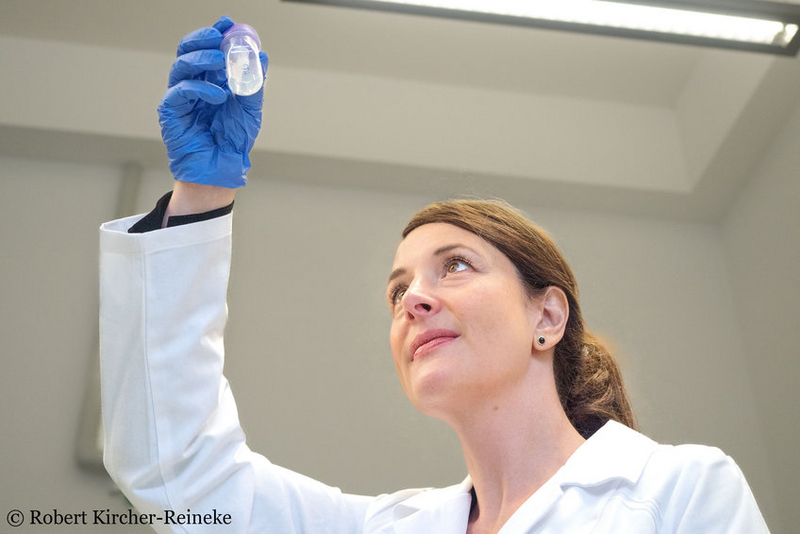
New Approaches in Malaria Research: The Potential of Tubulin as a Target for Antimalarial Drugs.
Year after year, millions of people worldwide become infected with malaria, and several hundred thousand die as a result of the infection. Malaria is caused by the single-celled parasite Plasmodium falciparum. No new class of antimalarial drugs has been introduced into clinical practice since 1996, while resistance to established antimalarial drugs is increasing.
The highly dynamic microtubule cytoskeleton plays an essential role in cell division, motility, and the structural integrity of malaria parasites. Because of this important role, compounds that inhibit the microtubule cytoskeleton have considerable potential as future antimalarial drugs. Until now, the development of parasite-specific tubulin-targeting drugs has been hampered by the lack of purified, functional parasite tubulin.
Recently, the interdisciplinary team led by Prof. Dr. Simone Reber succeeded in purifying and characterising Plasmodium tubulin and reconstructing the dynamic cytoskeleton in vitro. This enabled the identification of the first compounds that selectively inhibit the parasite’s cytoskeleton without affecting the human cytoskeleton. These technological advances now place the team in the unique position of being able to reconstruct the parasite’s cytoskeleton from purified components, investigate microtubule dynamics and mechanics in vitro, and identify additional parasite-specific microtubule inhibitors.
Principal Investigator:
Contact:
Publications:
(1) Reber S, Singer M & Frischknecht F (2024). Cytoskeletal dynamics in parasites. Current Opinion in Cell Biology, 86, 102277.
(2) Kletter T, Biswas A & Reber S (2022). Engineering metaphase spindles: Construction site and building blocks. Current Opinion in Cell Biology, 79, 102143.
(3) Hirst WG, Fachet D, Kuropka B, Weise C, Saliba K & Reber S (2022). Purification of functional Plasmodium falciparum tubulin allows for the identification of parasite-specific microtubule inhibitors. Current Biology, 32, 1–8.