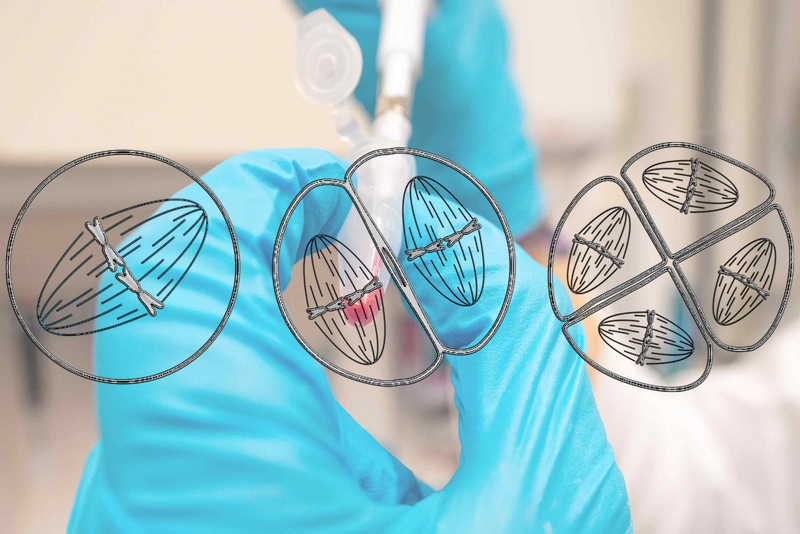
Development and Control of Subcellular Structures: Understanding Cell Division for Medical Applications
The team led by Prof. Dr. Simone Reber investigates how cells build their “mini-factories”—known as organelles—and why these structures have such precisely defined sizes and shapes. While this may sound abstract, the research has important practical applications: understanding how these structures form and function can provide valuable insights into what happens inside cells when normal processes are disrupted, for example in cancer and other diseases.
One example is the mitotic spindle, which ensures that a cell’s genetic material is accurately distributed between two daughter cells during cell division. This structure must have a precisely controlled size and shape to function properly. The team investigates how cells accomplish these complex tasks “automatically”—without a blueprint or architect.
In the long term, these findings may contribute to the development of new medical approaches, for example by enabling targeted intervention in cellular processes or providing a better understanding of disease mechanisms.
Principal Investigator:
Contact:
Publications:
(1) Ng SC, Biswas A, Huyton T, Schünemann J, Reber S & Görlich D (2023). Barrier-properties of Nup98 FG phases ruled by FG motif identity and inter-FG spacer length. Nature Communications, 14, 747.
(2) Meca E, Fritsch AW, Iglesias-Artola JM, Reber S & Wagner B (2023). Predicting disordered regions driving phase separation of proteins under variable salt concentration. Frontiers in Physics, 11, 1213304.
(3) Reusch S, Biswas A & Reber S (2020). Affinity-purification of label-free tubulins from Xenopus egg extracts. STAR Protocols, 1, 100151.
(4) Hirst WG, Biswas A, Mahalingan KK & Reber S (2020). Differences in intrinsic tubulin dynamic properties contribute to spindle length control in Xenopus species. Current Biology, 30(11), 2184–2190.
(5) Granada AE, Jiménez A, Stewart-Ornstein J, Blüthgen N, Reber S, Jambhekar A & Lahav G (2020). The effects of proliferation status and cell cycle phase on the responses of single cells to chemotherapy. Molecular Biology of the Cell, 31(8), 845–857.